



Following reading this page about how Pigment handles blank cells with metrics with different dimensions (How Pigment Handles Blank Cells), I have the following questions :
What is the best practice to maintain both source metrics values (e.g. treating blanks as zeros from the metric with the most dimensions) ?
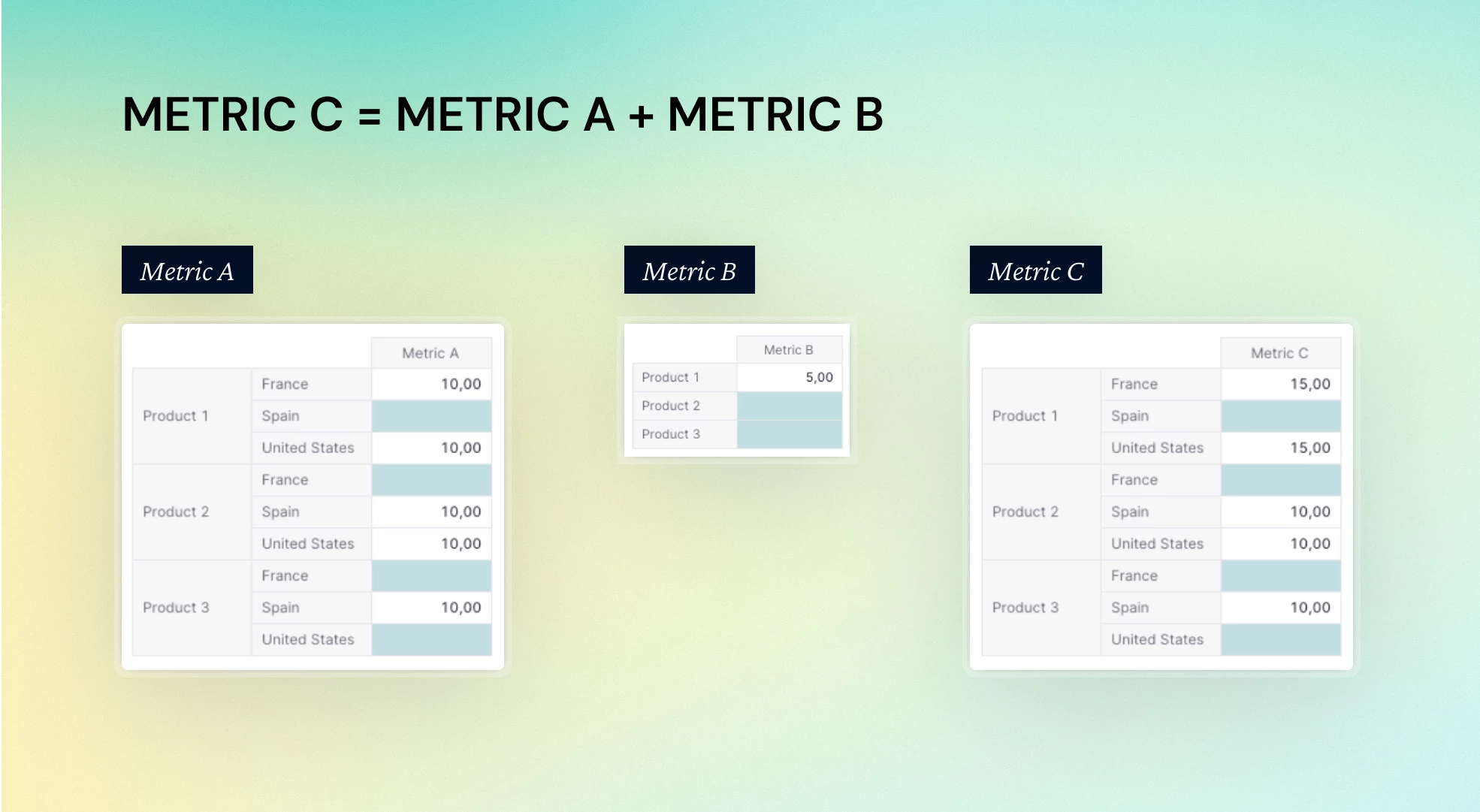
- e.g. if I want metric C to hold for Spain Metric A + Metric B = 5 instead of blank for Product A (in the case of different costs sources with different dimensions structures, total cost should always be A+B, not A+ depending whether A is not empty, add B) ?
- I make do with a simple Metric A + Metric B[Add : Country]
- Yet I wonder whether this would be the best option in term of keeping balance between performance + sparsity ?
Another question : are there plans to modify this default behaviour in the future ?
- I ask this because it is kind of counter intuitive to account for metric dimensionality discrepancies when dealing with mathematical operations like + and -
- I creates an additional intellectual workload for simple operations like + or - (accounting for a non neutral number which is blank)
- I requires the need to take into account source metrics dimensionalities when dealing with + or - when creating formulas or changing block structures, while * or / operations dont require this kind of attention (‘blank’ * ‘any numer’ will always result in ‘blank’ whatever their respective dimensions structures)
- Excel handles blank as 0 when it comes to + or -, so people coming from Excel (as lot of people do) would expect this