



Purpose
Pigment Stencil is an agent-led delivery methodology. The agent doesn't sit alongside the process, it drives it: turning customer context into a Design Doc, a Design Doc into a build-ready Spec, a Spec into a working solution and every decision along the way into Project Memory that outlives the project team. For the customer, that means faster time-to-value, lower total cost of ownership because knowledge doesn't walk out the door with the last consultant and de-risked delivery because every gate is governed by an artifact, and builds on patterns proven across every prior Pigment delivery.
Ask the Stencil agent. You can ask it about any project stage, Discovery through Sustain. It's the first move in every phase of a Pigment implementation, and the whole point of Pigment Stencil.
This isn't a traditional methodology with AI added on. The methodology runs on Prompt, Validate, Run:
- Prompt the agent to draft the heavy lifting
- Validate the result together
- Run your process as part of the project
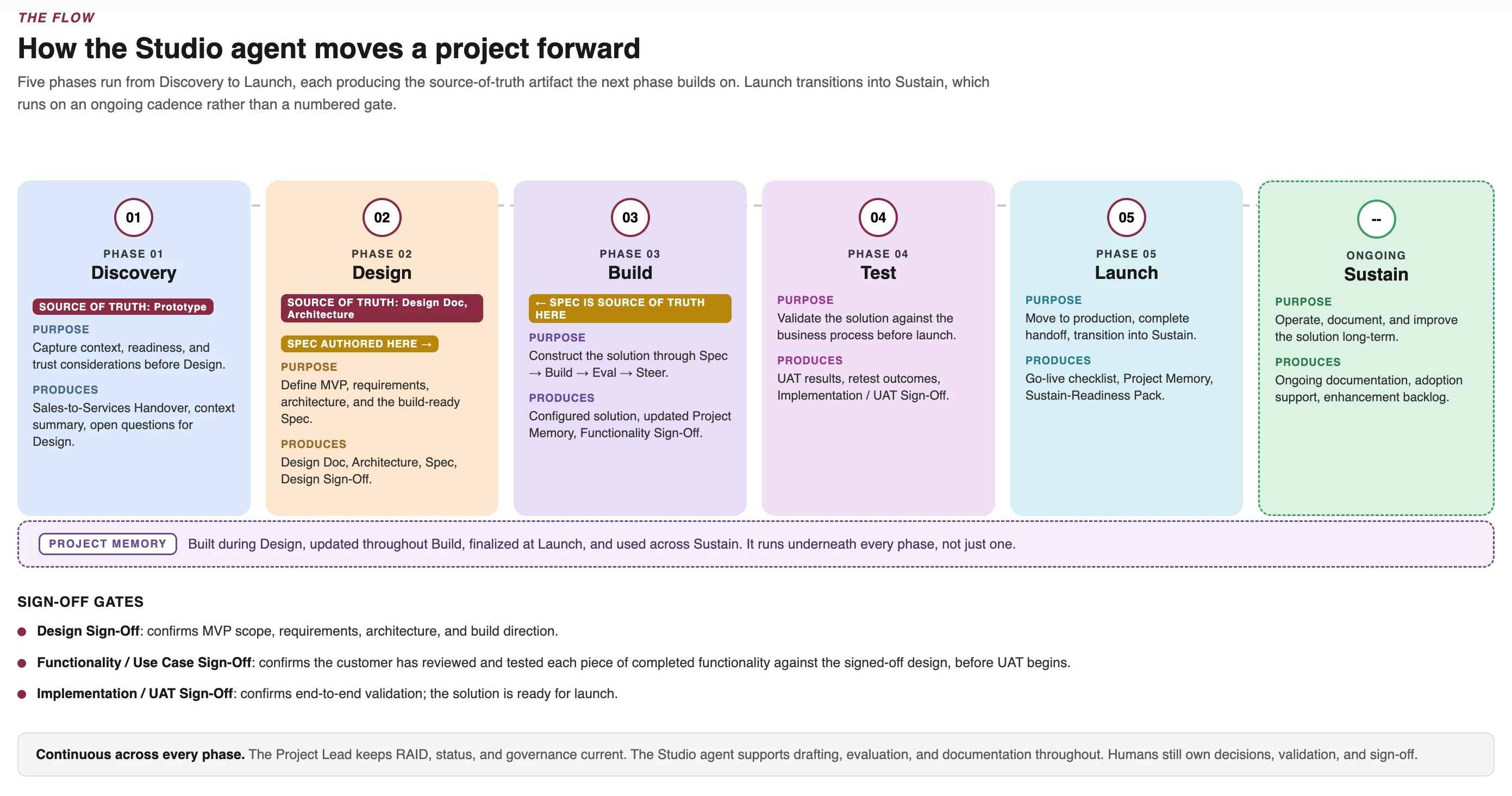
How the Stencil agent moves a project forward
What is changing
Delivery is agent-led. Don't read the methodology and go find the agent after. Ask the agent first; it applies this entire structure to your customer, your use case, your data, your timeline. That's the front door, not a footnote.
Context is captured earlier. Sales, Presales and PS scoping teams often know the customer's goals, business pain, prototype learnings, scope assumptions, risks, data constraints, compliance needs and success criteria before kick-off. Pigment Stencil gives that context a formal place within Discovery + Onboarding.
Knowledge is sustained after launch. Pigment Stencil extends Launch into Sustain so the customer has the documentation, support model, ownership cadence, adoption plan and Project Memory needed to operate and improve the solution after implementation.
What stays the same
Pigment Stencil keeps the core discipline of strong implementation:
- Clear scope and defined deliverables
- Customer ownership of the business process and its decisions
- Project governance and change management
- Data readiness
- Rigorous testing and formal sign-off
- Launch readiness and implementation quality standards
Key principles
| Principle | What it means |
| Capture context early | Preserve what is learned during Sales, Presales, scoping, prototype work and Implementation Readiness |
| Prepare before building | Turn validated inputs into the Design Doc, Architecture and build-ready Spec |
| Use agents with intention | Use Stencil agents to accelerate planning, drafting, evaluating, testing, documentation and hand-off |
| Keep humans accountable | People own decisions, scope, validation, approvals, customer communication and sign-off |
| Sustain knowledge after launch | Transition the customer into ownership with Project Memory, the Sustain-Readiness Pack and support guidance |