



Purpose
Clear ownership is one of the biggest drivers of a successful Pigment implementation, agent or no agent. This article is where Pigment Stencil draws the line: who's involved, what each team owns, how decisions get made and how governance keeps the project aligned and moving. The agent accelerates the visibility work, status, RAID and gap-spotting, but every decision, approval and sign-off in this article belongs to a named human, not a prompt.
Typical ownership model
Depending on the project structure, activities may be different
| Area | Customer owns | Pigment / Partner supports |
| Business process | Defines current and future process needs | Guides how to implement and optimize within Pigment |
| Scope and priorities | Confirms MVP priorities | Assesses feasibility, effort and trade-offs |
| Data readiness | Provides clean, structured, usable data | Helps load, connect and validate data |
| Decisions | Makes business decisions and resolves internal alignment | Facilitates decisions and explains options |
| Testing | Leads UAT and confirms business readiness | Supports issue resolution and technical validation |
| Documentation and training | Creates and maintains customer-specific materials | Provides walkthroughs, guidance and resources |
| Adoption | Prepares users and drives change internally | Supports adoption planning and CS transition |
Pigment / Partner roles
| Role | Primary responsibility |
| Customer Success Manager | Supports long-term success, adoption, value realization, launch transition and sustainment |
| Project Manager / Project Lead | Manages timeline, coordination, deliverables, risks, weekly PM activities and issue resolution |
| Solution Architect | Leads solution design, architecture, data approach, technical decisions, performance and scalability |
| Solution Modeler | Builds and configures applications, boards, calculations, workflows and model logic |
| Partner Team | Delivers implementation activities in alignment with Pigment Stencil standards |
Customer roles
| Role | Primary responsibility |
| Executive Business Sponsor | Champions the project, reinforces value, escalates issues and supports adoption |
| Project Owner | Drives the project internally, coordinates the customer team, removes blockers and keeps decisions moving |
| Business Process Lead | Owns process decisions, aligns SMEs and confirms requirements |
| Model Builder / Customer Modeler | Participates hands-on, learns the solution, supports build and prepares to maintain Pigment |
| Data Lead | Owns data readiness, source extracts, data quality and integration coordination |
| SMEs / End Users | Provide process knowledge, validate requirements, test the solution and give feedback |
| Change Champions | Support adoption and reinforce the change across impacted teams |
Decision-making
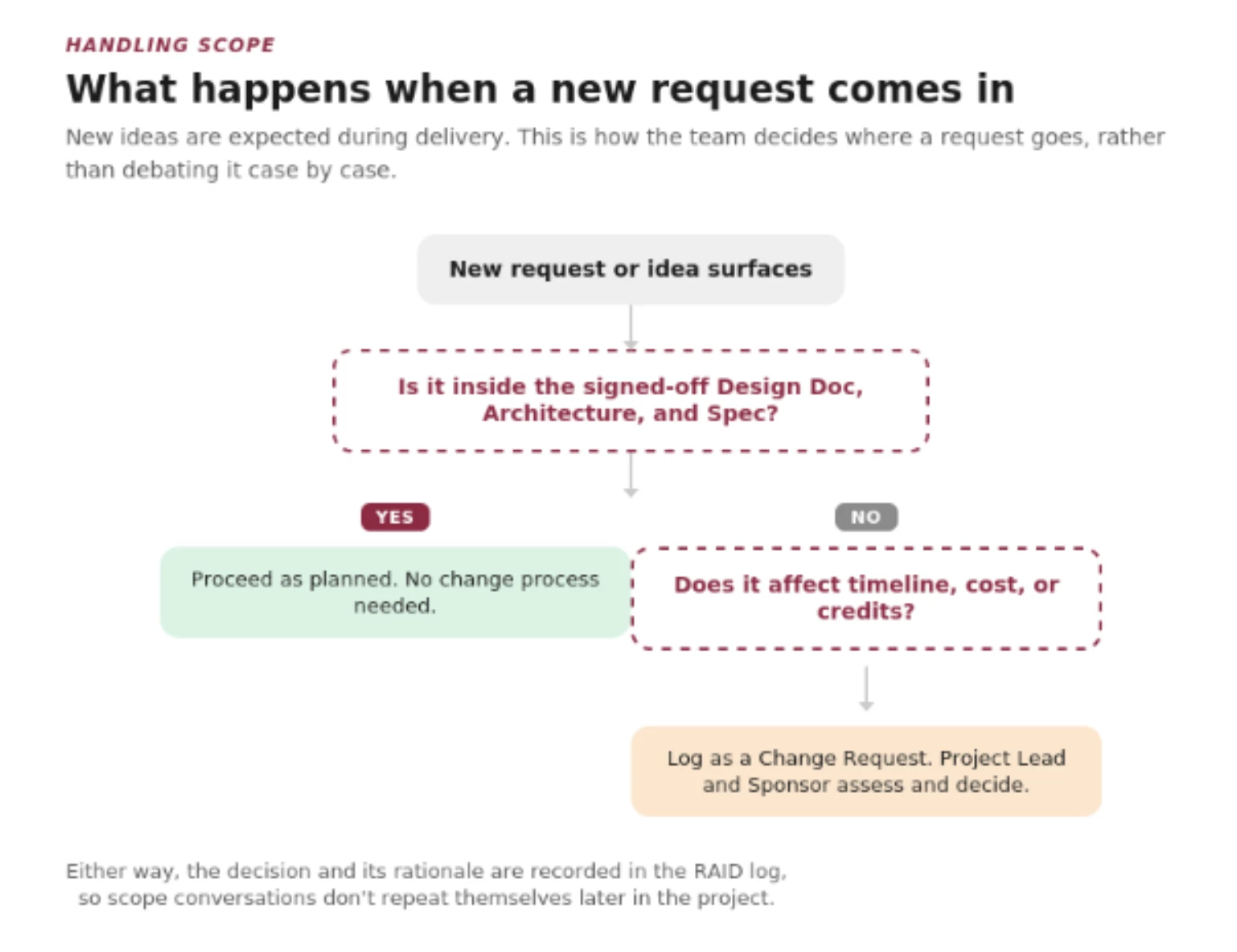
Projects move faster when decision ownership is clear. The customer should identify who can make decisions for each workstream, process, data area and approval point.
Decision-making should be guided by: the signed SOW, MVP priorities, customer value, timeline and budget, the Design Doc/Architecture/Spec, compliance requirements, downstream impact and go-live readiness.
Governance cadence
| Governance activity | Purpose |
| Sales-to-Services Handover | Transfers goals, scope assumptions, prototype context, risks and success criteria into delivery |
| Implementation Readiness Call | Aligns roles, expectations, preparation tasks, training needs, data readiness and Design inputs |
| Kickoff | Confirms goals, scope, team roles, project approach, timeline and next steps |
| Design / Requirements Workshops | Validates requirements, process flows, MVP scope, architecture inputs and design decisions |
| Build / Validation Working Sessions | Reviews build progress, validates functionality and resolves open questions |
| Weekly PM Sync | Reviews timeline, risks, blockers, actions, decisions, scope changes, dependencies and milestones |
| Status Updates | Summarize progress, risks, blockers, decisions, completed work, upcoming work and changes |
| SteerCo / Leadership Checkpoints | Escalates major decisions, resolves leadership-level blockers and maintains sponsorship |
| Sign-Offs | Confirms formal agreement at key points |
Source-of-truth ownership
| Artifact | Primary owner | Purpose |
| Prototype | Sales / Presales, with delivery review | Discovery + Onboarding input |
| Design Doc | Solution Architect, with customer validation | MVP scope, requirements, assumptions, decisions and open questions |
| Architecture | Solution Architect | Technical solution structure |
| Spec | Solution Architect / Solution Modeler | Build-ready instructions |
| RAID Log | Project Lead | Risks, actions, issues and decisions |
| Project Memory | Delivery team, with CS transition support | Implementation record for support and sustainment |
| Sustain-Readiness Pack | Delivery team / CS | Launch hand-off package |
Sign-off ownership
| Sign-off | Customer owns | Pigment / Partner supports |
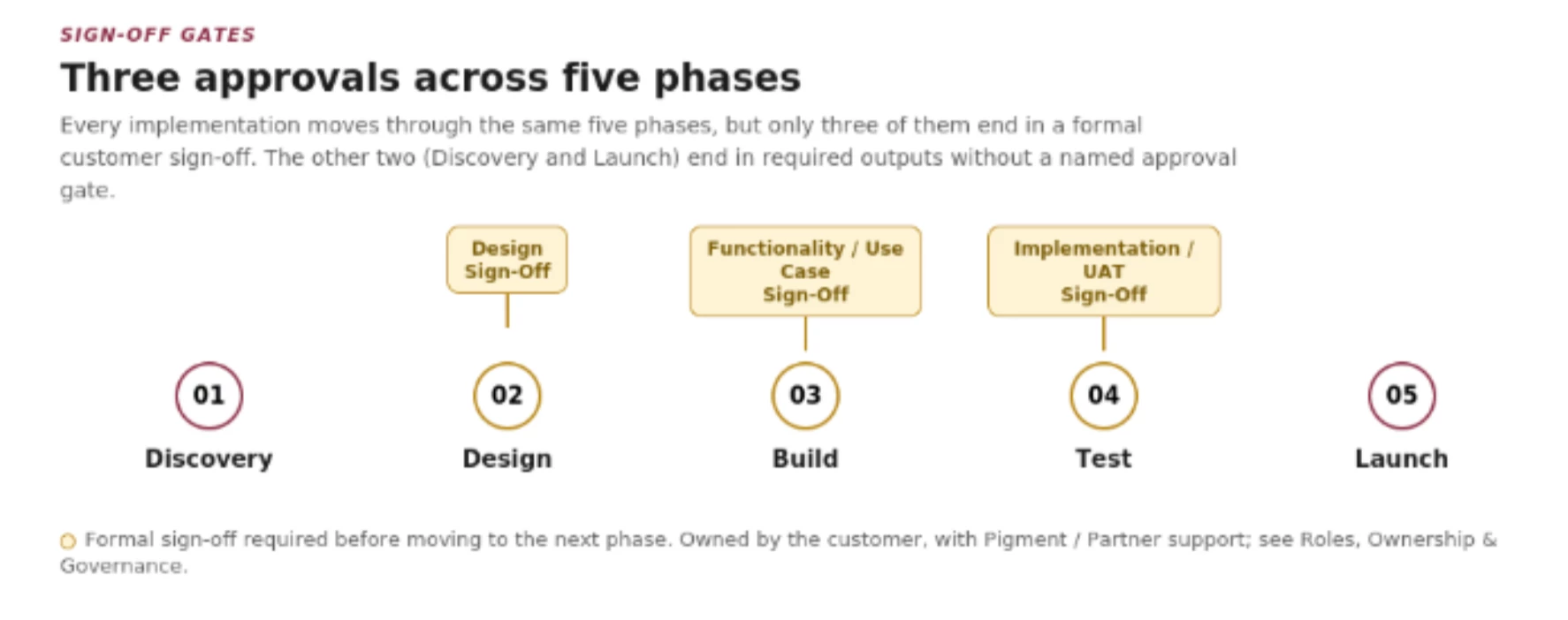
| Design Sign-Off | Approval of MVP scope, requirements, process, architecture, assumptions and build direction | Prepares design materials, explains trade-offs and resolves open questions |
| Functionality / Use Case Sign-Off | Approval that completed functionality aligns with the signed-off design and is ready for testing | Supports walkthroughs, issue resolution and evidence gathering |
| Implementation / UAT Sign-Off | Approval that the solution has been tested, validated and is ready for launch | Supports defect resolution, launch readiness and hand-off |
Recommended practices
- Set ownership early: confirm the sponsor, project owner, modelers, business process leads, data lead and SMEs before Design begins.
- Keep the SOW and Design Doc visible as the reference point for scope and change discussions.
- Make decision rights explicit.
- Use regular governance to surface risks early.
- Treat sign-offs as alignment points, not ceremonies.
- Use AI to improve visibility: summaries, action items, decision logs and risk notes help the team move faster when reviewed and owned by people.